Dependency Hell or Heaven
TLDR; Is Deno heading down the same dependency hell path as Node, due to the use
of the deps.ts & mod.ts conventions?
Introduction
Node.js, or rather the conventions introduced by the npm ecosystem, is infamous for it's dependency hell problems.
When Deno came along, with it's import just what you need approach, there seemed to be some light at the end of this tunnel.
I believe though, that some unfortunate conventions and advice has emerged within the Deno ecosystem that could lead us back into this dependency hell situation, although probably not to the extent of npm.
What am I talking about?
deps.ts
It's commonly suggested to put all your dependencies into a deps.ts module so
you don't need to maintain absolute URLs in your imports everywhere.
This means that all your modules that have a dependency actually depend on ALL of your dependencies not just what that module needs.
I know import maps are probably a better solution for an app, but they aren't suitable for use inside library modules.
(I'm using the term library loosely to mean a collection of associated modules, generally within a common repo, and deployed together somewhere like deno.land/x/library. I know these are also known as modules, but I use library to make the distinction for the sake of this discussion).
mod.ts
Another suggestion for library authors is to expose all modules via a mod.ts.
This leads to consumers of your library depending on everything in your library rather than just the parts they actually need.
Dependency Hell
If the whole Deno ecosystem followed both of these patterns everywhere (thankfully it doesn't), we'd spiral into a similar dependency hell as npm.
Here's an illustration of my point:
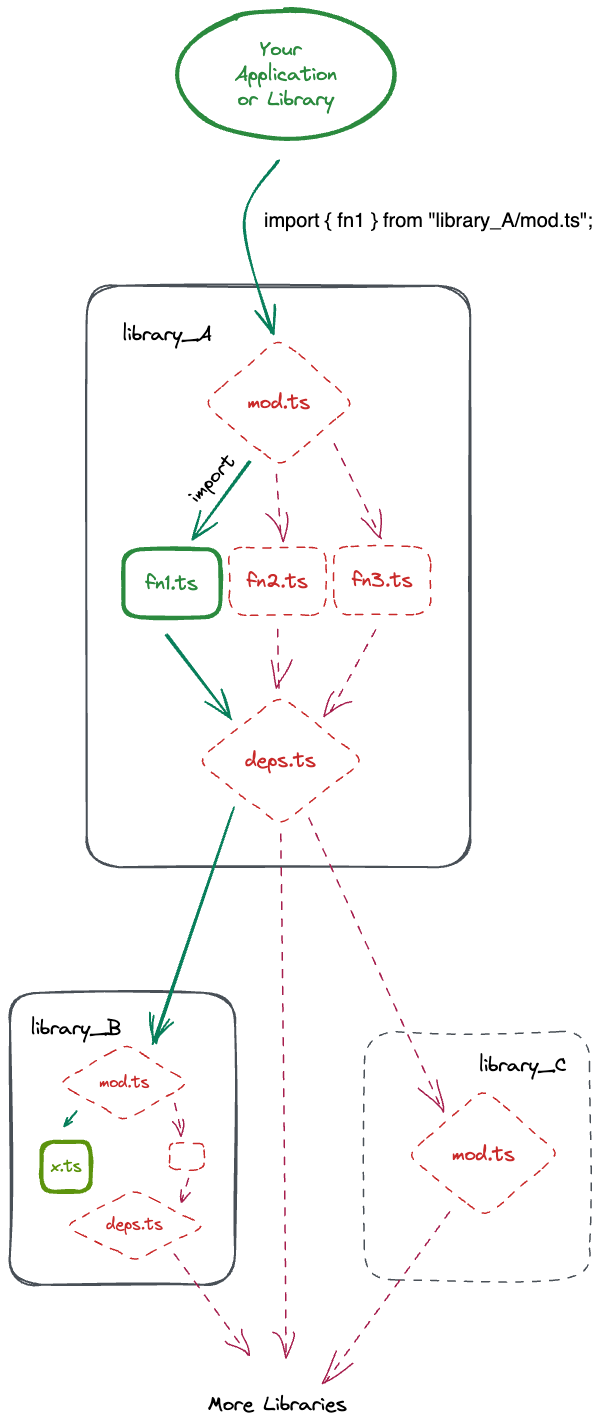
The Application only wants fn1, and only it's necessary transitive deps (in
green/bold), but by following the deps.ts & mod.ts pattern, it's getting
everything else (in red/dashed) regardless that it doesn't need it.
Dependency Heaven
So how can we fix this?
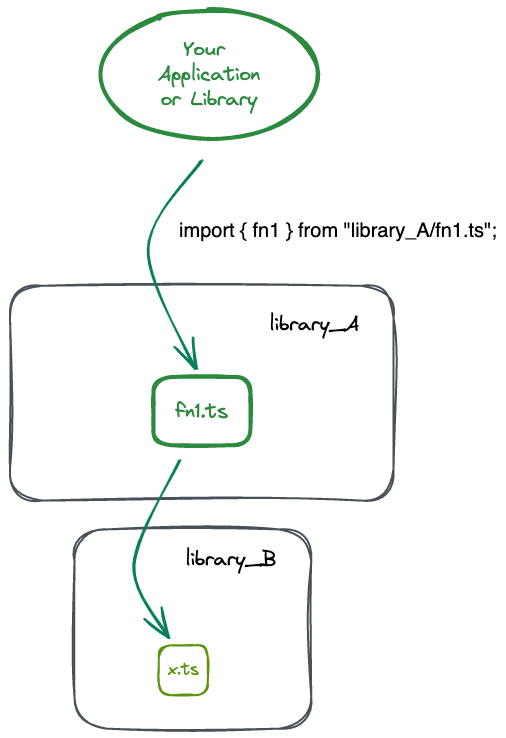
The app could import the fn1 directly from the fn1.ts module, and that in
turn just imports the specific modules directly from another library.
The elephant in the room
Ok, but this means libraries need to have absolute URL imports throughout rather
than centralised in a single deps.ts.
What exactly is wrong with that?
You have to find and replace URLs?
Is that so bad when weighed up against dependency armageddon?
Maybe all we really need is a little extra tooling to aid maintenance of these imports. To find and replace with a bit more context.
As for mod.ts, I'll admit it is very convenient to just import mod.ts and
have all things available, but it doesn't foster a healthy ecosystem.
Maybe what we need there is better module discovery within the IDEs, or a de-mod
tool that allows you to start off using a mod.ts import and then it expands
that out into direct imports.
Put your money where your mouth is
I know I've pointed out problems, and only presented a half-arsed solution, and I'm keen to rectify that. I'm hoping to actually get some time to work on the tools I talk of. In the meantime, I hope this stirs up some ideas and healthy discussion.
If you'd like to discuss this subject further please use the GitHub discussion.